Enterprise Infrastructure Management
A cloud-agnostic, multi-region, multi-account infrastructure provisioning framework designed to scale across hundreds of components — built with Terramate, Terragrunt and Terraform.
The Problem
Most companies face the same infrastructure challenges as they scale — this project was designed to solve them systematically.
Manual Provisioning Waste
Engineering teams spend weeks setting up infrastructure manually, repeating the same steps across environments and regions with no consistency guarantees.
Configuration Drift Risk
Without automated drift detection, infrastructure silently diverges from its intended state — leading to outages, security gaps and costly debugging sessions.
No Cost Visibility
Infrastructure changes get merged without any understanding of their cost impact. Teams discover budget overruns months after the fact.
Vendor Lock-In Fears
Tightly coupling provisioning workflows to a single cloud provider makes migration painful and limits negotiation leverage.
What I Built
A production-grade infrastructure framework that eliminates manual work, enforces consistency and works across any cloud provider.
Multi-Region Architecture
Dev, QA and Production environments deployed across multiple AWS accounts and regions (US & EU) — with isolated state and independent lifecycles.
Automated CI/CD Pipelines
Five distinct pipelines: change preview, cost estimation (Infracost), security scanning (Tfsec), automated provisioning and drift detection — all triggered via pull requests.
Cloud-Agnostic Design
The folder structure and orchestration layer are provider-independent. Currently using AWS, but switching to GCP or Azure requires only changing module references — zero workflow changes.
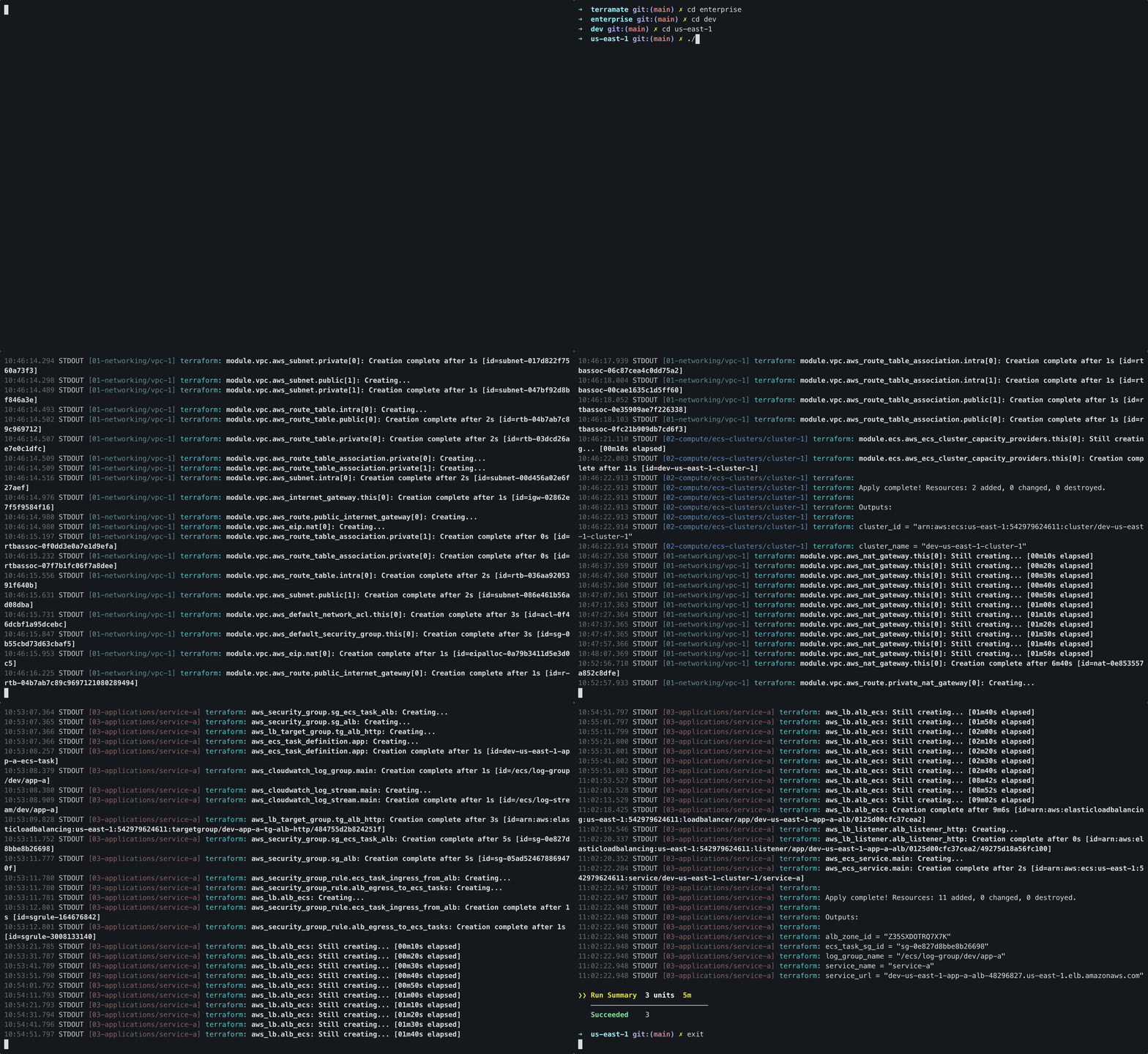
[03-applications/service-a] terraform: Outputs:
[03-applications/service-a] terraform:
[03-applications/service-a] terraform: alb_zone_id = "Z35SXDOTRQ7X7K"
[03-applications/service-a] terraform: ecs_task_sg_id = "sg-0e827d8bbe8b26698"
[03-applications/service-a] terraform: log_group_name = "/ecs/log-group/dev/app-a"
[03-applications/service-a] terraform: service_name = "service-a"
[03-applications/service-a] terraform: service_url = "dev-us-east-1-app-a-alb-48296827.us-east-1.elb.amazonaws.com"

❯❯ Run Summary  3 units  5m
    ────────────────────────────
    Succeeded    3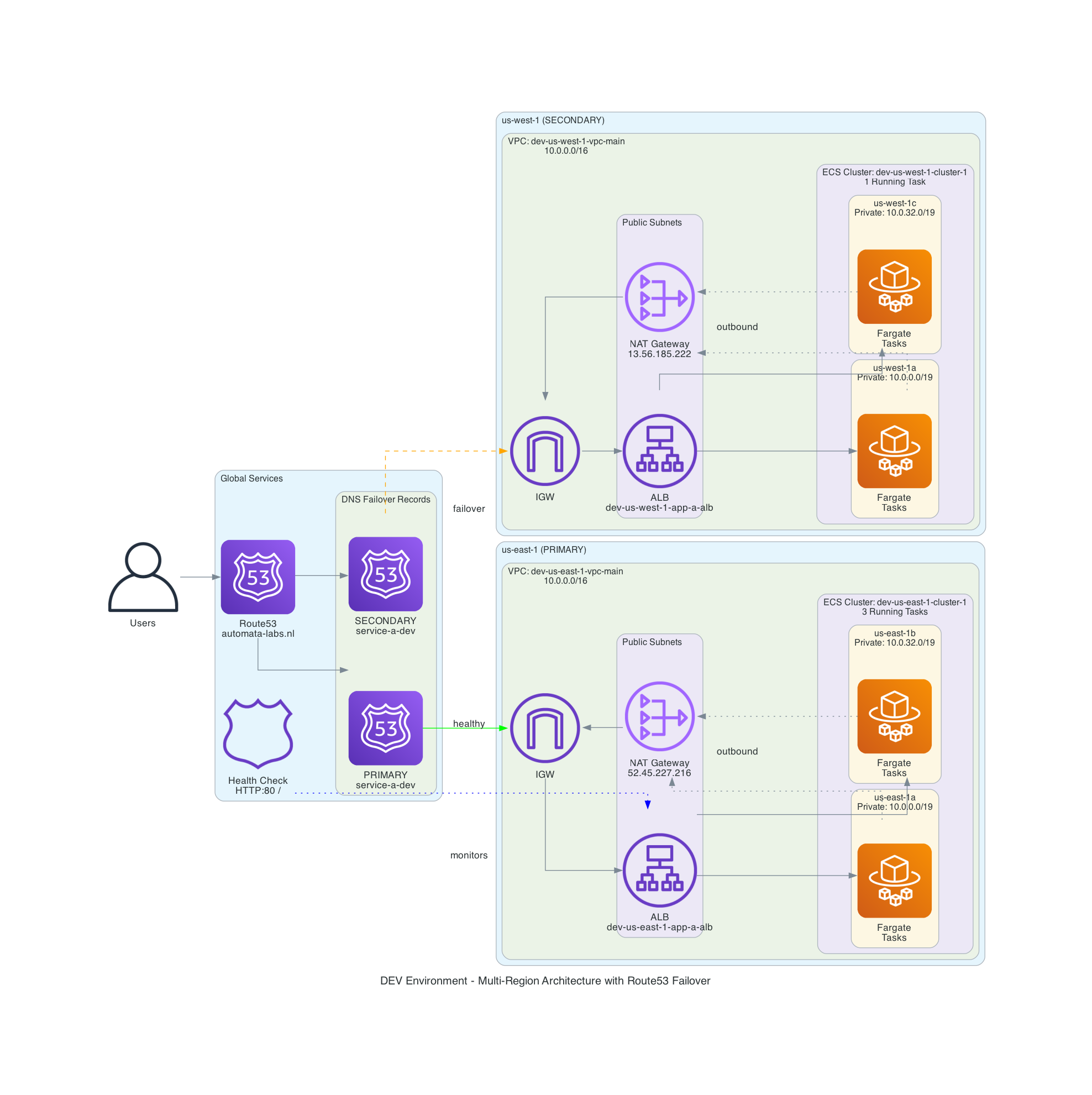
➜  terramate git:(main) ✗ curl dev-us-east-1-app-a-alb-48296827.us-east-1.elb.amazonaws.com

<!DOCTYPE html>
<html>
<head>
<title>Welcome to nginx!</title>
<style>
html { color-scheme: light dark; }
body { width: 35em; margin: 0 auto;
font-family: Tahoma, Verdana, Arial, sans-serif; }
</style>
</head>
<body>
<h1>Welcome to nginx!</h1>
<p>If you see this page, the nginx web server is successfully installed and
working. Further configuration is required.</p>

<p>For online documentation and support please refer to
<a href="http://nginx.org/">nginx.org</a>.<br/>
Commercial support is available at
<a href="http://nginx.com/">nginx.com</a>.</p>

<p><em>Thank you for using nginx.</em></p>
</body>
</html>
Technical Deep Dive
Here's how it works under the hood.
Four-Tier Infrastructure Model
A layered architecture — Networking → Compute → Applications → Monitoring — with proper dependency ordering and blast radius reduction. Each layer can be provisioned independently.
- Expandable: companies can add, remove, or reorder layers to fit their specific needs
- Each tier has its own state file, reducing blast radius
- Clear dependency chain ensures correct provisioning order
Cloud-Agnostic Architecture
The folder structure and orchestration layer (Terramate + Terragrunt) are completely provider-independent. Currently deployed on AWS, but the identical workflow applies to GCP or Azure.
- Swap AWS module references for GCP/Azure equivalents — no workflow changes needed
- Orchestration logic stays the same regardless of cloud provider
- Eliminates vendor lock-in at the provisioning layer
Drift Detection
Scheduled and on-demand drift monitoring across all environments, synced to Terramate Cloud for centralized visibility.
- Multi-environment scheduled scans
- On-demand checks via GitHub Actions
- Results synced to Terramate Cloud dashboard
Cost Analysis
Every pull request includes an automated cost estimate via Infracost, giving teams full visibility into the financial impact of infrastructure changes before they're merged.
- PR-level cost breakdowns
- Monthly cost projections
- Cost diff between current and proposed state
Security Scanning
Automated security analysis with Tfsec on every PR, catching misconfigurations and compliance violations before they reach production.
- Infrastructure security best practices enforced automatically
- Compliance checks integrated into CI/CD
- Blocks merges on critical security findings
State Management
S3 + DynamoDB backend with encryption, versioning and access logging — ensuring safe concurrent operations and full auditability.
- State locking via DynamoDB prevents concurrent modifications
- Encryption at rest and in transit
- Versioned state files for rollback capability
Key Outcomes
The measurable results this framework delivers out of the box.
4
Infrastructure Layers
Expandable to each company's needs
3+
Environments
Dev, QA, Production — extensible to more
N
Regions
Any number of regions, any cloud provider
5
CI/CD Pipelines
Preview, Cost, Security, Deploy, Drift
∞
Cloud Providers
AWS, GCP, Azure — swap modules, same workflow